Press Release · National Institute of Standards and Technology
Quantum Physics Can Verify a Person’s Location, NIST Researchers Show
Distributed by WebGuard Core · Originally issued via National Institute of Standards and Technology

Imagine a corporate treasurer directing her company’s financial network to make a $50 million wire transfer. How can the network be certain the command is coming from a secure terminal in the company’s headquarters, and not a hacker’s laptop across the globe?
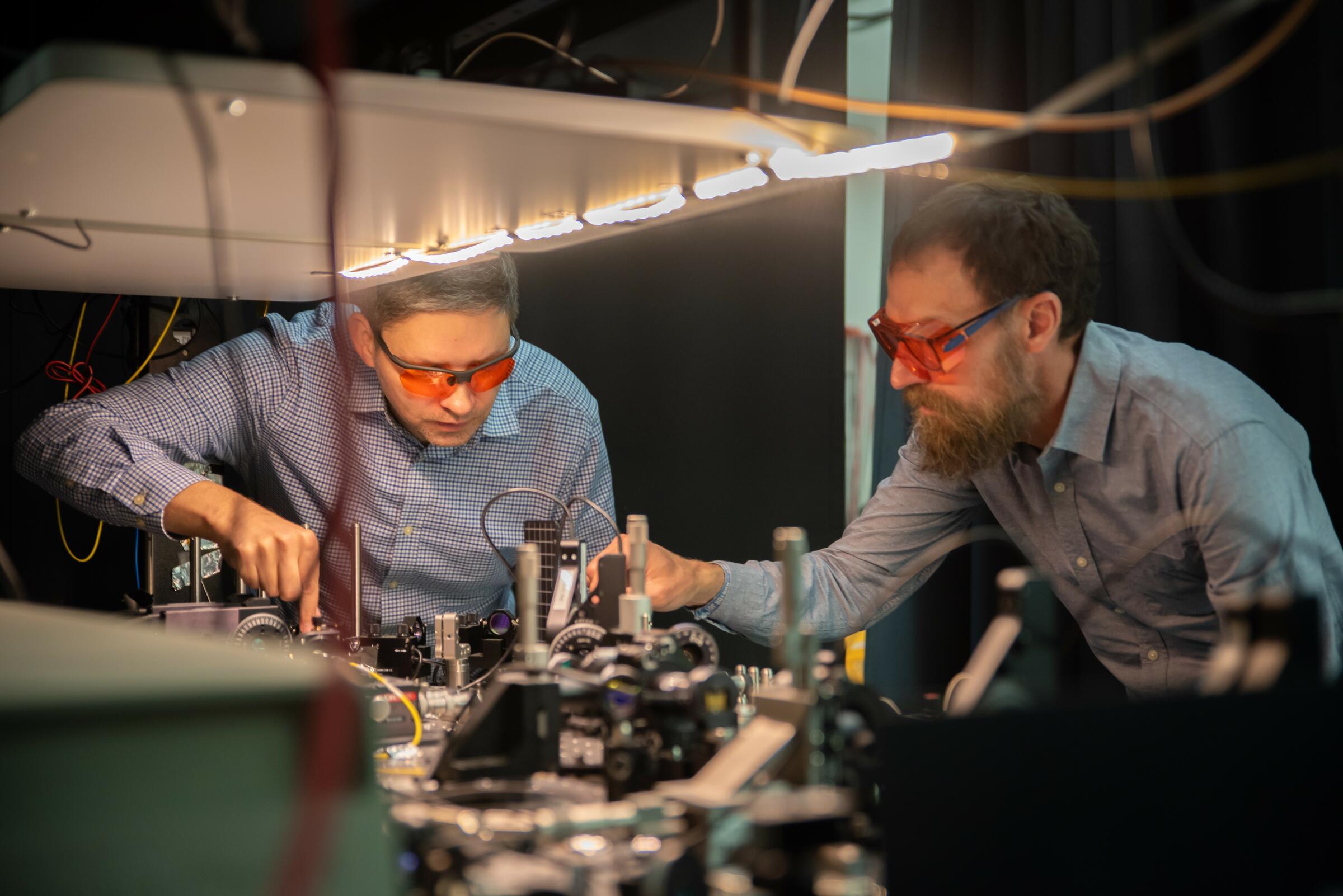
In a first-of-its-kind experiment, scientists at the National Institute of Standards and Technology (NIST) and their colleagues have demonstrated that the quirks of quantum mechanics can definitively confirm the location of a person. Using exquisitely sensitive quantum sensors and quantum technologies developed at NIST, physicist Krister Shalm and an international team of collaborators eliminated loopholes that had left other quantum-based verification strategies vulnerable to fraudsters.
The researchers reported their findings this week in Nature.
Applying the technique to a real-life situation may be more than a decade away, noted NIST physicist Scott Glancy, a study collaborator. That’s because researchers are still developing the tools that will allow quantum computers and sensors to accurately share quantum information in large-scale networks.
By preventing people outside a specific location from accessing data, the technique has the potential to:
- Safeguard healthcare records and other private information.
- Prevent remote adversaries from issuing commands to critical infrastructure such as nuclear plants, power grids and water treatment facilities.
- Stop hackers from making unauthorized stock transactions in a firm’s trading account.
- Thwart phishing attacks based on video or phone calls from unknown locations.
- Cybercrimes cost U.S. citizens more than $16 billion in 2024. Far fewer than 1% of cybercriminals are caught, in part because many of the thieves operate from outside the country.
“Our results show how digital security can instead be anchored to the physical world,” said Shalm. “Gaining access to a system can only be done by someone who can prove they are in a particular location — such as a bank — thwarting remote would-be hackers.”
Shalm and his collaborators employed a procedure known as quantum position verification (QPV), in which two trustworthy parties, called the verifiers, seek to confirm the location of a third person, dubbed the prover. To make that determination, the verifiers task the prover with measuring a particular property of a photon — a particle of light – and then reporting back the results.
On the NIST campus in Boulder, Colorado, the team built two verifying stations 195 meters apart, connected by electrical cables and ultrathin optical fibers threaded through the corridors of a research building. The purported location of the prover resided somewhere in between them.
In the first step of the experiment, one of the verifiers creates a pair of photons that possess a uniquely quantum property known as entanglement. Entangled particles are so inextricably linked that measuring a property of one particle automatically reveals the property of the other — even if the two particles lie on opposite sides of the galaxy.
In the team’s plan, the verifier keeps one of the entangled photons and sends the other to the prover. The verifiers each send random numbers timed to arrive simultaneously at the prover’s assumed location. The prover uses the random numbers to compute how to measure a particular property of the entangled photon — its polarization, or the direction in which the electric field of the particle wiggles as it travels through space.
The prover then sends their measurement to the verifiers. Based on how much time elapsed from the moment the verifiers sent the random bits to the prover to when they received the response back, the verifiers can work together to triangulate where the prover is located.
This procedure is repeated millions of times over the course of a few minutes. The verifiers then look at how often the polarization measurements they made on their entangled photon match those of the entangled photon sent to the prover. A quantum principle known as the no-cloning theorem dictates that these correlations are destroyed by anyone attempting to copy and distribute the information to colluding partners.
By passing a test known as a loophole-free Bell test, which proves that the entangled photons are more closely correlated than classical physics allows, the verifiers can be certain that the prover is really in the targeted location and not just pretending to be in that place.
The Bell test can be passed only if the prover consistently measures the entangled photon according to the instructions specified by the verifiers’ random numbers. Because those instructions are random, fraudsters cannot predict them and use the predictions to send early responses back to the verifiers, confounding their ability to determine the true location of the prover.
Any experimental error or manipulation of the quantum devices by adversaries will cause the Bell test to fail, exposing the cheater. If the Bell test succeeds, the verifiers can be certain that the prover is in the correct location and that the quantum devices functioned correctly. “If the Bell test succeeds, the verifiers can be certain that the prover is in the correct location and that the quantum devices functioned correctly.”
The cosmic speed limit — that nothing can travel faster than the speed of light — also played a role in the experiment. If the prover were located outside the region in which he professes to reside, the person would take longer than expected to report his measurements to the verifiers. That delay would expose the prover as an imposter.
Although scientists have been trying to demonstrate QPV for decades, “our experiment is the first complete demonstration of such a protocol,” Shalm said.
Using QPV to assure a customer that they are truly communicating with someone in their bank’s building will require high-fidelity quantum communication networks, added Glancy. Such networks will share entangled photons between the customer and their bank.
“NIST and many other research organizations and companies are developing the technologies that will support such a quantum network,” he said.
Quantum Advances at NIST
Several technologies pioneered at NIST enabled the researchers to successfully conduct their experiment. These include superconducting nanowire single-photon detectors, which were crucial for capturing nearly every photon in the experiment. If too many photons are missed, it would be impossible to pass the Bell test, and even an honest prover would not be able to convince the verifiers that they are in the target location.
In addition, the team relied on a fast, highly efficient method to generate a source of entangled photons, which NIST scientists created a decade ago.
“All of these technologies combined, along with the expertise of our research team, provided us with the tools we needed,” said NIST physicist Krister Shalm.
Paper: Gautam Kavuri et al. Quantum position verification with remote untrusted devices. Nature. Published online Nov. 18, 2026. DOI: 10.1038/s41586-026-11247-3.